Pearson Edexcel · A-Level · English Literature
Course version: 9ET0 · Version from Sept 2015
Poetry – Section A: Post-2000 Poetry – Poems of the Decade: An Anthology…
Full specification wording
Component 3: Poetry – Section A: Post-2000 Poetry – Poems of the Decade: An Anthology of the Forward Books of Poetry 2002–2011: The Furthest Distances I’ve Travelled Leontia Flynn
Leontia Flynn’s ‘The Furthest Distances I’ve Travelled’ contrasts the restless backpacking of youth with the profound emotional journeys of adulthood.
Checked against the Pearson Edexcel 9ET0 specification (opens in a new tab) on .
- Point 11 of 20
- 4 key terms
Study notes
From the checked teaching notes for this specification point.
The idea
Leontia Flynn’s ‘The Furthest Distances I’ve Travelled’ contrasts the restless backpacking of youth with the profound emotional journeys of adulthood. The poem shifts from a romanticised view of global travel, marked by exotic place names and transient experiences, to the grounded reality of domestic life. Flynn utilises a conversational tone, irregular rhyme schemes, and enjambment to reflect the chaotic, fragmented nature of her early travels. As the poem progresses, the focus narrows to the intimate connections between people, suggesting that the most significant distances we traverse are psychological. The conclusion reveals that true discovery lies not in geographical exploration, but in human intimacy and shared personal histories.
What earns the marks
- Analyse the shift in tone from the energetic, restless youth to the reflective, settled adulthood.
- Evaluate the use of enjambment and fragmented stanza structures to mirror the transient nature of backpacking.
- Explore the significance of the physical souvenirs and how they represent the fading memories of physical travel.
- Examine the concluding metaphor that human relationships constitute the most significant 'distances' travelled.
Common mistakes and how to put them right
Treating the poem solely as a narrative about a holiday.
Put it right: Focus on the metaphorical journey from youth to maturity and the changing values associated with it.
Ignoring the structural evolution.
Put it right: Analyse how the poem's form becomes more stable as the speaker's lifestyle settles.
Misinterpreting the ending as regretful.
Put it right: Recognise the speaker's mature acceptance that emotional connections are more valuable than geographical conquests.
Exam tips
- Link the theme of identity and personal growth in Flynn's work to other coming-of-age poems in the anthology.
- Discuss the impact of the colloquial language and self-deprecating humour on the poem's accessibility and tone.
- Pay close attention to the final stanza, using it to demonstrate how the poem's central thesis on human connection is resolved.
Try the lesson
The start of the Component 3: Poetry – Section A: Post-2000 Poetry – Poems of the Decade: An Anthology of the Forward Books of Poetry 2002–2011: The Furthest Distances I’ve Travelled Leontia Flynn lesson, made from checked teaching notes for this specification point.
Have a go first
In Leontia Flynn's 'The Furthest Distances I've Travelled', what does the speaker ultimately conclude about the nature of travel?
Listen
Leontia Flynn’s ‘The Furthest Distances I’ve Travelled’ contrasts the restless backpacking of youth with the profound emotional journeys of adulthood. The poem shifts from a romanticised view of global travel, marked by exotic place names and transient experiences, to the grounded reality of domestic life. Flynn utilises a conversational tone, irregular rhyme schemes, and enjambment to reflect the chaotic, fragmented nature of her early travels. As the poem progresses, the focus narrows to the intimate connections between people, suggesting that the most significant distances we traverse are psychological. The conclusion reveals that true discovery lies not in geographical exploration, but in human intimacy and shared personal histories. A strong answer earns marks for these points. Analyse the shift in tone from the energetic, restless youth to the reflective, settled adulthood. Evaluate the use of enjambment and fragmented stanza structures to mirror the transient nature of backpacking. Explore the significance of the physical souvenirs and how they represent the fading memories of physical travel. Examine the concluding metaphor that human relationships constitute the most significant 'distances' travelled. A common slip: Treating the poem solely as a narrative about a holiday. Instead, focus on the metaphorical journey from youth to maturity and the changing values associated with it. Exam tip: Link the theme of identity and personal growth in Flynn's work to other coming-of-age poems in the anthology.
See it
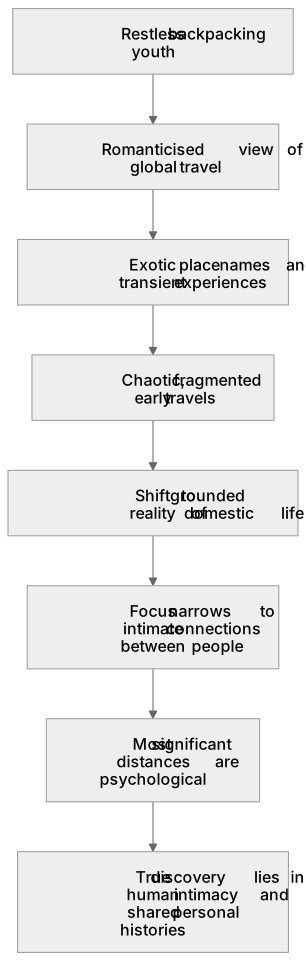
Put it in order
Put these steps in the order they happen.
- 1. Shift to grounded reality of domestic life
- 2. True discovery lies in human intimacy and shared personal histories
- 3. Focus narrows to intimate connections between people
- 4. Restless backpacking of youth
- 5. Romanticised view of global travel
- 6. Most significant distances are psychological
- 7. Exotic place names and transient experiences
- 8. Chaotic, fragmented early travels
Key words
Say what each word means before you turn the card.
Travel and journeys
Try answering aloud or in your head before turning the card.
Identity and maturity
Try answering aloud or in your head before turning the card.
Memory and the past
Try answering aloud or in your head before turning the card.
Human relationships
Try answering aloud or in your head before turning the card.
See every definition
- Travel and journeys
- The poem contrasts restless backpacking in youth with the profound emotional journeys of adulthood, suggesting the most significant distances traversed are psychological.
- Identity and maturity
- The poem traces a metaphorical journey from youth to maturity, with the speaker's mature acceptance that emotional connections are more valuable than geographical conquests.
- Memory and the past
- Physical souvenirs represent the fading memories of physical travel, while shared personal histories are valued in the poem's conclusion.
- Human relationships
- The concluding metaphor presents human relationships as the most significant 'distances' travelled, with true discovery lying in human intimacy.
Label the diagram
Some boxes have lost their names. Pick the right name for each number.
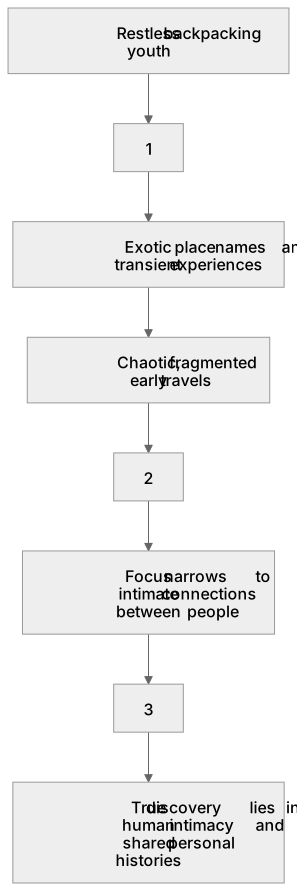
1Box 1
2Box 2
3Box 3
There is more to this lesson
The full lesson goes on to check your understanding and help you earn the marks. Create a free account to carry on, with your progress saved.
A week of Premium from your first lesson · Then the free plan continues · No card, no charge
Test your understanding of Component 3: Poetry – Section A: Post-2000 Poetry – Poems of the Decade: An Anthology of the Forward Books of Poetry 2002–2011: The Furthest Distances I’ve Travelled Leontia Flynn
Active recall beats re-reading. Take an instant quiz now to test what you’ve learned and lock it into long-term memory.
A week of Premium from your first lesson · Then the free plan continues · No card, no charge